Row One's historic sports products are not affiliated with, licensed, sponsored, authorized, or endorsed by any college, university, team, league, artist, athlete, coach, venue, other brand, or any licensing entity.
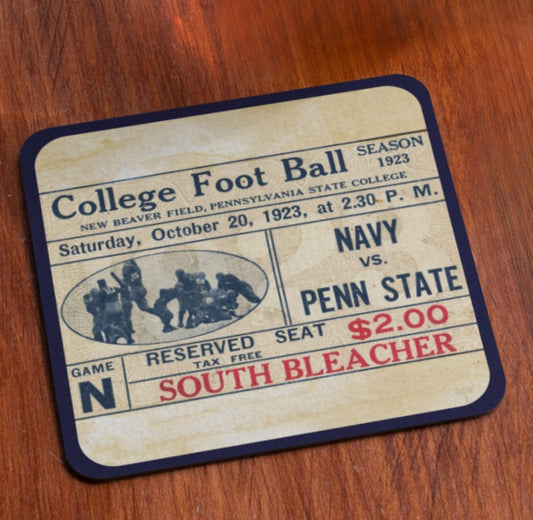
Row One Brand is an American sports brand founded over a decade ago. Row One offers over 20,000 historic sports wall art prints created from sports artifacts in the public domain under U.S. Federal Copyright Law like the historic 1923 Navy Midshipmen at Penn State Nittany Lions ticket art above. This ticket design was published in 1923 and published without a copyright notice.
The publication was never copyrighted and this beautiful ticket design fell into the public domain 102 years ago. The publication's copyright was never registered or renewed according to a U.S. Copyright Office Records Search.
Team names on our tickets and programs identify who played in the game and have extreme historical significance. Without the words "Navy" and "Penn State" on this 1923 art, it loses all historical significance. Who played in the game?
It is our position based on U.S. Federal Copyright Law that Row One is not required to decide which part of this art design to erase, "black out," or censor. Once an artistic work is in the public domain, it stays there regardless of what words might be embedded within the art design. If we were required to erase words or artistic elements aka "censor" aspects of historic artwork, the historic publications, magazines, books, tickets, cover art, cartoons, photos, and films we use to create our unique sports history products would not portray history accurately.
"Brands" and prestigious public universities with great academic programs do not own everything that relates to them from the 1800s to present day. In other words, public universities and sports brands do not own history.
ROW ONE STRIVES TO PORTRAY HISTORY ACCURATELY
Row One's historic sports art is not affiliated with, licensed, sponsored, authorized, or endorsed by any college, university, team, league, artist, athlete, coach, venue, other brand, or any licensing entity.
Team names appearing on tickets and program covers serve the extremely important function of describing who played in the game and are important historical facts. Similarly, words appearing below or embedded within cartoon drawings or 70 year old college mascot art describe who the cartoon represents and are descriptive of the artwork. Without those words, you have no idea what team the 100 year old tiger art represents.
It is Row One's position that it is not required to erase or remove elements, words, or art embedded within old historic publications, drawings, cartoons, books, magazines, program covers, and tickets in the public domain under U.S. Federal Law.
Row One uses old historic cover art, tickets, schedules, magazines, books, films, cartoons, photos, illustrations, and paintings in the public domain under U.S. Federal Copyright Law to create our unique sports products. Once a creative work's copyright expires, it falls into the public domain. Row One also uses many items that were never copyrighted either due to failure to copyright the item or a conscious decision not to copyright the material.
Row One's physical college football memorabilia collection includes thousands of historic college football tickets and programs. The collection dates back to an 1876 Harvard-Yale football program and Row One's oldest game ticket is an 1893 Princeton Tigers vs. Pennsylvania Quakers college football ticket.
Team names appearing on old tickets and historic cover art are an extremely important component of the designs because they describe who played or what team the art represents. Row One strives to portray history accurately and it is our position that we are not required to remove or "censor" any aspect of our historic public domain creative works.
It is Row One's position that no college or university, pro team, artist, "brand," or publishing company has sole ownership of historic works of art, books, magazines, programs, tickets, game footage, songs, drawings by third party artists, and publications in the public domain under U.S. Federal Copyright Law and that no license is needed to use historic public domain materials.
The Public can use Public Domain works without permission, authorization, or approval from any licensing entity including prestigious academic brands.
Another prime example is Row One's 1930 Alabama football art from a very rare dance program card. The words "Pax Crimson Tide" are embedded all around the 1930 football punter art created by an unknown artist for a 1930 Rose Bowl Game Dance program. The University of Alabama does not own the 1930 football art design. Nobody owns it exclusively because it fell into the public domain 95 years ago. Row One is not required by law to erase and alter the art so that it merely reads "Pax."
A famous Alabama artist, Phil Neel, created numerous works with his signature on the art in which the words "Alabama," "Crimson Tide," and "Roll Tide" were written by him as part of the overall cover art design. These historic creative works in the 1960s and 1970s were not copyrighted. They can be reproduced and Row One does not have to censor Phil Neel's cover art regardless of what words he included in the design. Row One does not have to remove the word "Alabama" or "Auburn" from Neel's works. These works of art were created long before the days of collegiate licensing.
These works of art are not owned by any artist, prestigious academic university, team, league, or "BRAND."
Creative materials that Row One uses include old songs, films, footage, books, magazines, drawings, cover art, game ticket designs, paintings, cartoons, movies, illustrations, photos, and works of art that no longer have copyright protection. Trademark law cannot be used to extend protection for materials within the realm of copyright law.
Row One's historic sports art is not affiliated with, licensed, sponsored, authorized, or endorsed by any college, university, team, league, artist, athlete, coach, venue, other brand, or any licensing entity.
Old tickets are like chapters from a historic book. Each week tells a different story. Historic books can be reproduced exactly as they were written. So can old cover art, cartoons, paintings, photos, magazines, and historic tickets in the public domain.
Row One Brand Historic Coasters